

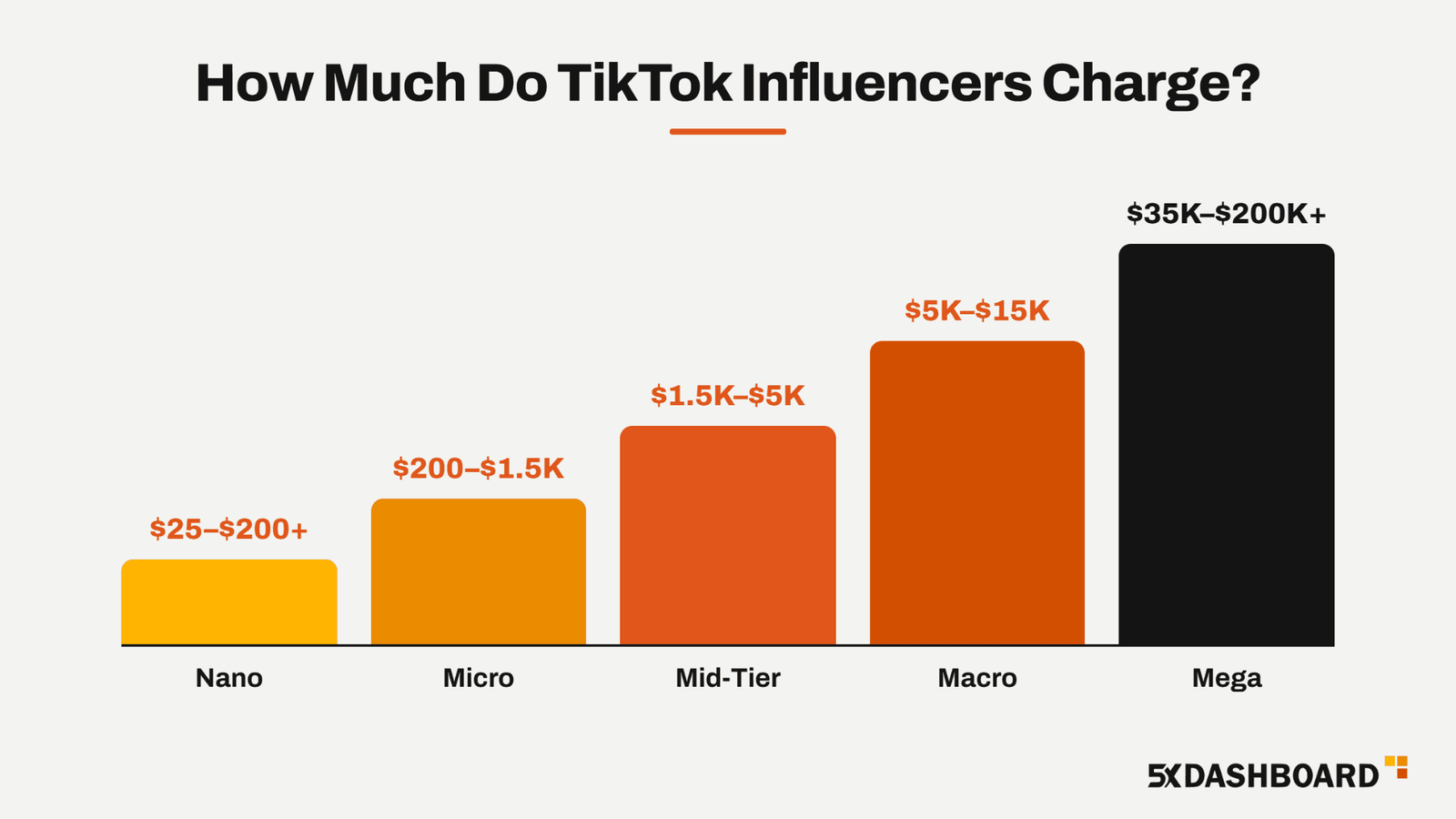
TikTok influencer rates generally range from $25 to $200+ for nano-influencers and climb to $35,000–$200,000+ for mega-influencers per standard in-feed sponsored video.
Our TikTok Shop agency has worked on TikTok Shop since March 2024 and has generated over $43 million in GMV across our sellers in the last 12 months. We also run a community of 2,300+ creators and have built the #1 marketing app on the TikTok Shop App Store.
That means we track what thousands of creators sell, so we know which creators are worth their fee. If you pay creators based on follower count, you can lose money on the video. This guide shows how much to pay creators, whether a flat fee or commission, and how to tell if a creator is worth paying.
How Much Do TikTok Influencers Charge?
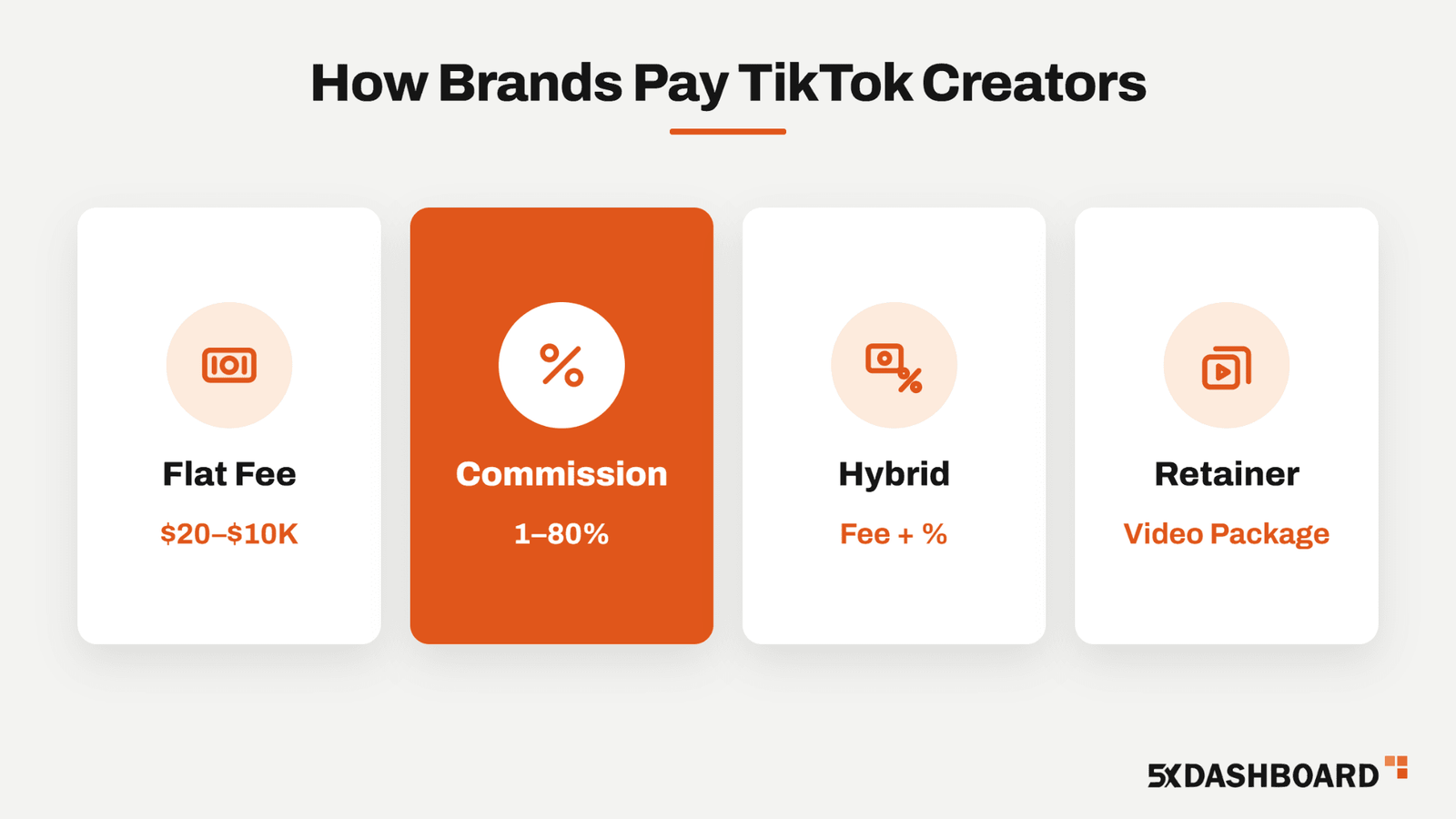
TikTok influencers charge a flat fee per video, a commission on each sale, or both. Brands selling on TikTok Shop can set up either deal inside TikTok Shop:
- Flat fee: TikTok Shop flat fee collaborations let you pay a creator between $20 and $10,000 for one video.
- Commission: You set a commission from 1% to 80% of each sale in TikTok Shop affiliate collaborations.
- Retainer: You pay the creator a set fee for a package of videos, usually at a lower price per video.
Follower count is a weak guide to what a creator is worth. In May 2026, a 9K-follower creator we matched with Wyze sold $98.5K on TikTok Shop. A 698.1K-follower creator we matched with Medicube sold $12.8K.
TikTok Influencer Rates By Tier
TikTok influencer rates increase with follower count. Here is what creators typically charge per video at each tier.
| Tier | Followers | Rate per video |
|---|---|---|
| Nano | 1,000 to 10,000 | $25 to $200+ |
| Micro | 10,000 to 100,000 | $200 to $1,500 |
| Mid-tier | 100,000 to 500,000 | $1,500 to $5,000 |
| Macro | 500,000 to 1M | $5,000 to $15,000 |
| Mega | 1M+ | $35,000 to $200,000+ |
Nano Influencers
Nano influencers have 1,000 to 10,000 followers and charge $25 to $200+ per video. Some creators accept free product or commission instead of a fee. Check that a creator meets the TikTok Shop affiliate requirements before you offer commission.
Small creators can still sell a lot. We matched Wyze with two nano creators who run TikTok Shop deal accounts. In May 2026, one creator with 5.2K followers sold $50.9K, and the other with 9K followers sold $98.5K.
Micro Influencers
Micro influencers have 10,000 to 100,000 followers and charge $200 to $1,500 per video. Check each creator's average views and sales history before you agree to a fee.
We matched CINCOM with a creator who has 15.7K followers. One video from this creator reached 42.7M views and made $124K+ in sales in under 30 days.
Mid-Tier Influencers
Mid-tier influencers have 100,000 to 500,000 followers and charge $1,500 to $5,000 per video. A higher rate makes sense when the creator's niche matches your product.
We matched Medicube, a skincare brand, with a licensed pharmacist who has 389.3K followers. Most of this creator's sales come from beauty products, and the account sold $351.3K in May 2026.
Macro Influencers
Macro influencers have 500,000 to 1 million followers and charge $5,000 to $15,000 per video. A larger audience does not guarantee more sales, so ask for sales and view data from recent videos before you pay a macro rate.
A beauty creator we matched with Medicube has 698.1K followers and sold $12.8K in May 2026. The pharmacist above has about half as many followers and sold 27 times more.
Mega Influencers
Mega influencers have over 1 million followers and charge $35,000 to $200,000+ per video. The TikTok Shop flat fee tool caps payments at $10,000 per creator, so you pay a mega fee outside TikTok Shop under your own contract.
TikTok Rates By Content Type
Posted Videos
The creator films the video and posts it on their account. You get their followers, and anyone the For You feed shows it to. The TikTok Shop flat fee tool covers single-video collaborations only, so each posted video is its own invite.
UGC Videos
The creator films the video and hands it to you. You post it on your account or run it as an ad. Medicube and CINCOM use our TikTok creator management service to get a steady supply of UGC videos from matched creators. You should agree in writing on where you can use the video and for how long.
Flat Fee Vs Commission Deals On TikTok Shop
Flat Fee Per Video
In a TikTok Shop flat fee collaboration, you pay upfront when you send the invite. You pay from your Available balance or by credit or debit card. The platform holds the money until the video passes review. The rules:
- Fee range: $20 to $10,000 per creator
- One video per collaboration
- Up to 50 creators per invite
- Up to 3 review rounds, each with a 14-day window
- Your money comes back if the creator rejects or ignores the invite, or fails to deliver an approved video after 3 rounds
A flat fee costs the same whether the video sells or not.
Commission-Only Deals
With commission only, you pay nothing upfront. The creator earns a set percentage of each sale made through their video or link. The TikTok Shop affiliate program lets you set this rate from 1% to 80%.
We helped COCOL go from $0 to $132K in monthly GMV in 4 months on affiliate and creator sales alone, without any paid ads.
The commission rate you set changes your costs directly. For Craftzee, we held commission at 9.5% of GMV. The category norm is 15% to 20%. Craftzee made $125,000 in sales that month, so 9.5% commission came to $11,875. At 15% to 20%, the commission would have been $18,750 to $25,000.
Hybrid Deals
In a hybrid deal, you pay a smaller flat fee plus commission. The TikTok Shop flat fee tool lets you add a 0% to 80% sales commission and a Shop Ads commission on top of the fee. You pay the flat fee upfront for the video, then commission only on sales it generates.
Retainers And Video Packages
With a retainer, you pay the creator a set fee for a package of videos. This lowers your cost per video. Avenlur was a new shop selling products priced at $129 to $519. Instead of paying top creators, we hired seven creators with a $60K to $70K sales history and paid each one $20 to $30 per video for 7 to 10 videos.
In month 3, one of the seven creators still had no sales, so the owner stopped paying retainers. We switched to commission-only deals, and creators kept posting videos. Within 5 months, Avenlur reached $156K in monthly sales without spending anything on retainers after month 3.
What Affects TikTok Influencer Rates
Average Views
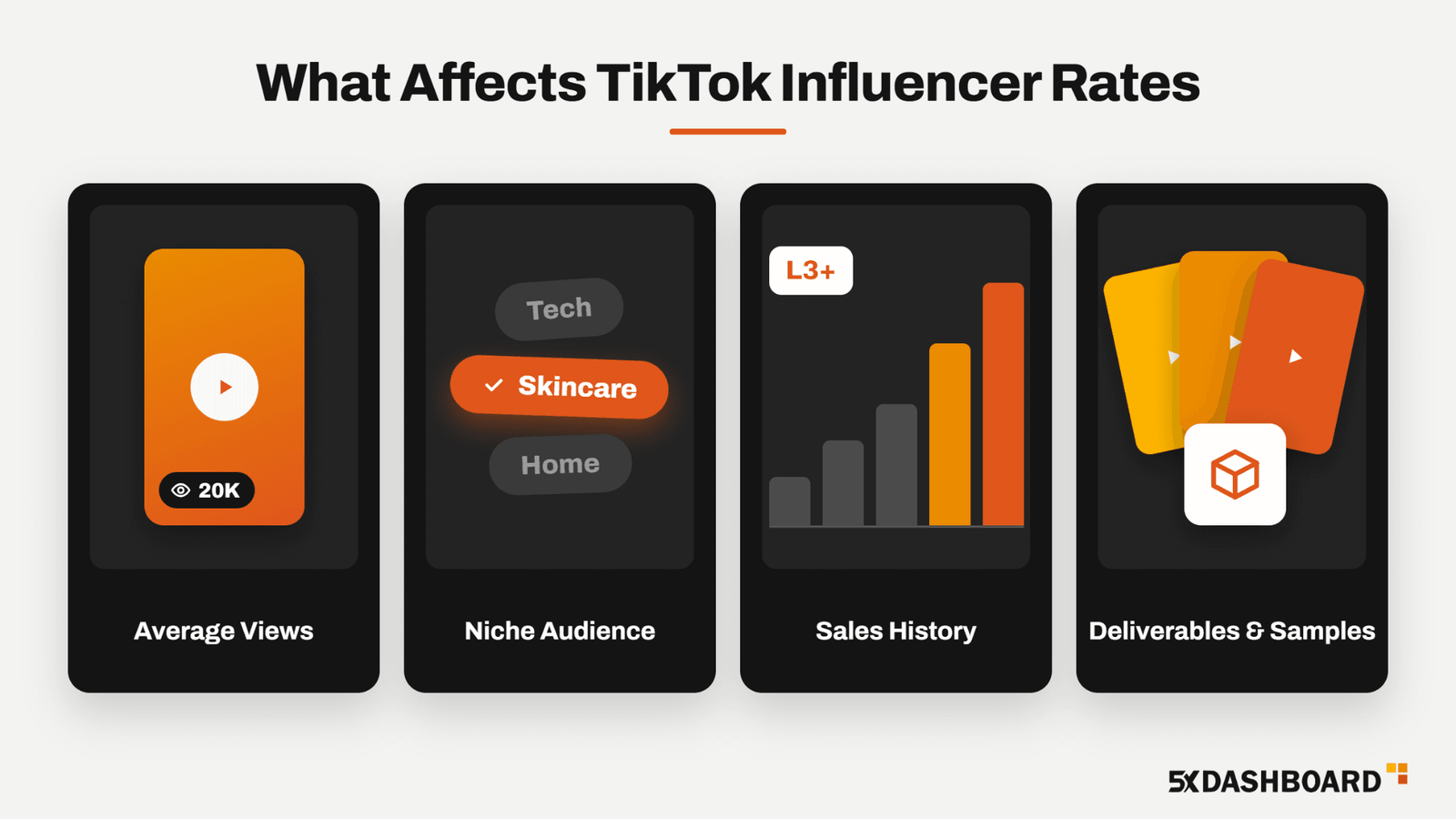
According to TikTok Newsroom, follower count is not a direct factor in how TikTok recommends videos. A creator's views tell you more about reach than their follower count. Ask for the average views on their recent videos, and base your offer on that number.
Niche
Creators with a clear niche, like skincare or tech, can charge more because their followers buy in that category. You should pay the higher rate only when their niche matches your product.
Sales History
TikTok Shop shows how much each creator has sold. Creators with strong sales can charge more because they have proof their videos sell. We prioritize L3+ creators (with $25,000+ in sales over the last 28 days). Check a creator's recent sales before you agree to a fee.
Deliverables And Samples
The more you ask a creator to do, the higher the price. These requests increase the fee:
- More than one video
- Extra rounds of edits
- A short deadline
- Rights to use the video in your ads
- Exclusivity, which blocks the creator from working with your competitors
If you send free product samples, add their cost to your budget too.
TikTok Rates Vs Instagram Rates
TikTok creators usually charge less than Instagram creators with the same follower count, especially at the nano and micro tiers. At the macro and mega tiers, the gap narrows because many big creators charge the same on both platforms.
Each platform shows creator videos to people in a different way, so check different metrics on each one before you set a fee.
On TikTok, follower count isn't a direct factor in the For You feed, so videos can reach people who don't follow the creator. On Instagram, reach depends on the format. The Instagram ranking guide says:
- Stories show posts from accounts you follow.
- Feed mixes accounts you follow with recommended accounts.
- Most Reels people see come from accounts they don't follow.
Base your fee on the metric that matches the format:
- TikTok videos and Instagram Reels: Average views.
- Instagram Stories: Follower count, since mostly followers see them.
- Instagram Feed posts: Follower count and average reach.
Running a creator's video as an ad also works differently. On TikTok, the creator sends you a Spark Ads code. On Instagram, the creator gives you permission to run partnership ads from their account. If a creator posts on both platforms, include both permissions in the contract.
Usage Rights And Other Add-On Fees
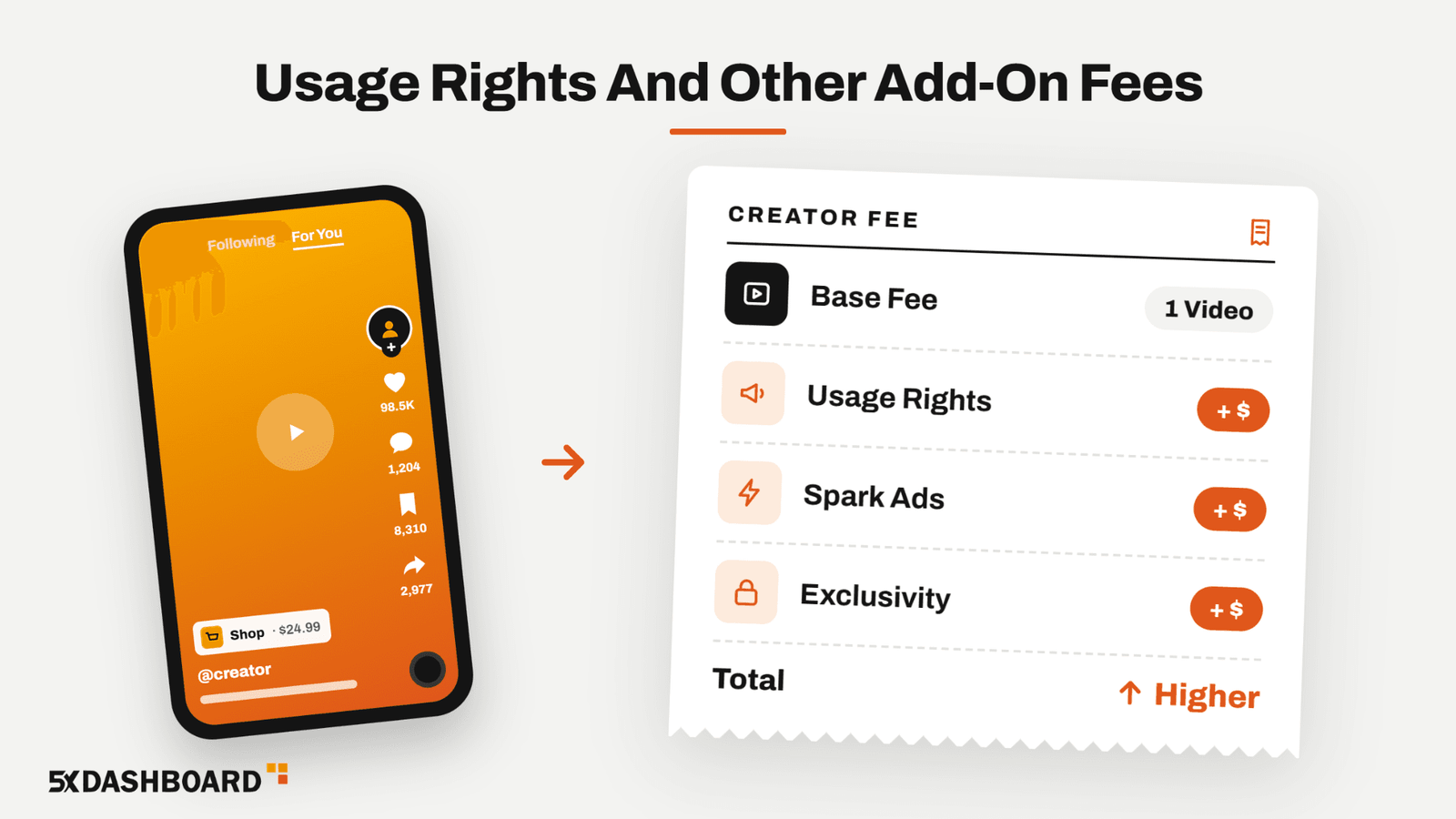
A creator's base fee covers one video posted on their own account. Anything beyond that costs extra, such as running the video as an ad or stopping the creator from working with your competitors. Here are the three common add-ons:
Usage Rights
Usage rights let you use the creator's video outside their account. Each use is priced separately:
- Running the video as an ad
- Posting it on your own account
- Editing it into new videos
In the contract, list each use, how long you can use it, and the agreed price.
Spark Ads
Spark Ads let you run a creator's TikTok post as a paid ad from their account. The creator generates a code in their post's ad settings and sets how long you can use it: 7, 30, 60, or 365 days. Ask for the period that matches how long you plan to run the ad. You can also use Spark Ads videos in your TikTok Shop ads on GMV Max.
Exclusivity
Exclusivity stops a creator from promoting competing brands for a set period. Since they give up income during that time, they charge more for it. To keep the fee down, name specific competitors in the contract and set an end date.
How To Tell If A Creator Rate Is Fair
Compare the creator's fee with what they deliver: views, engagement, or sales. Run these three checks using the creator's numbers.
Cost Per View
Formula: Fee ÷ average views × 1,000
A $500 fee for a creator averaging 20,000 views works out to $25 per 1,000 views. Compare this figure across the creators on your list.
Cost Per Engagement
Formula: Fee ÷ (average views × engagement rate)
Engagement rate is likes, comments, and shares per view. At 20,000 views and a 5% engagement rate, a video gets 1,000 engagements, so a $500 fee costs $0.50 per engagement.
Cost Per Sale
Formula: Fee ÷ average GMV per video
This check only works on TikTok Shop, where you can see each creator's sales. If a creator averages $5,000 in GMV per video and charges $500, the fee equals 10% of expected sales. If that's higher than the commission rate you'd pay, offer commission instead.
How To Negotiate TikTok Influencer Rates
Send A Clear Brief First
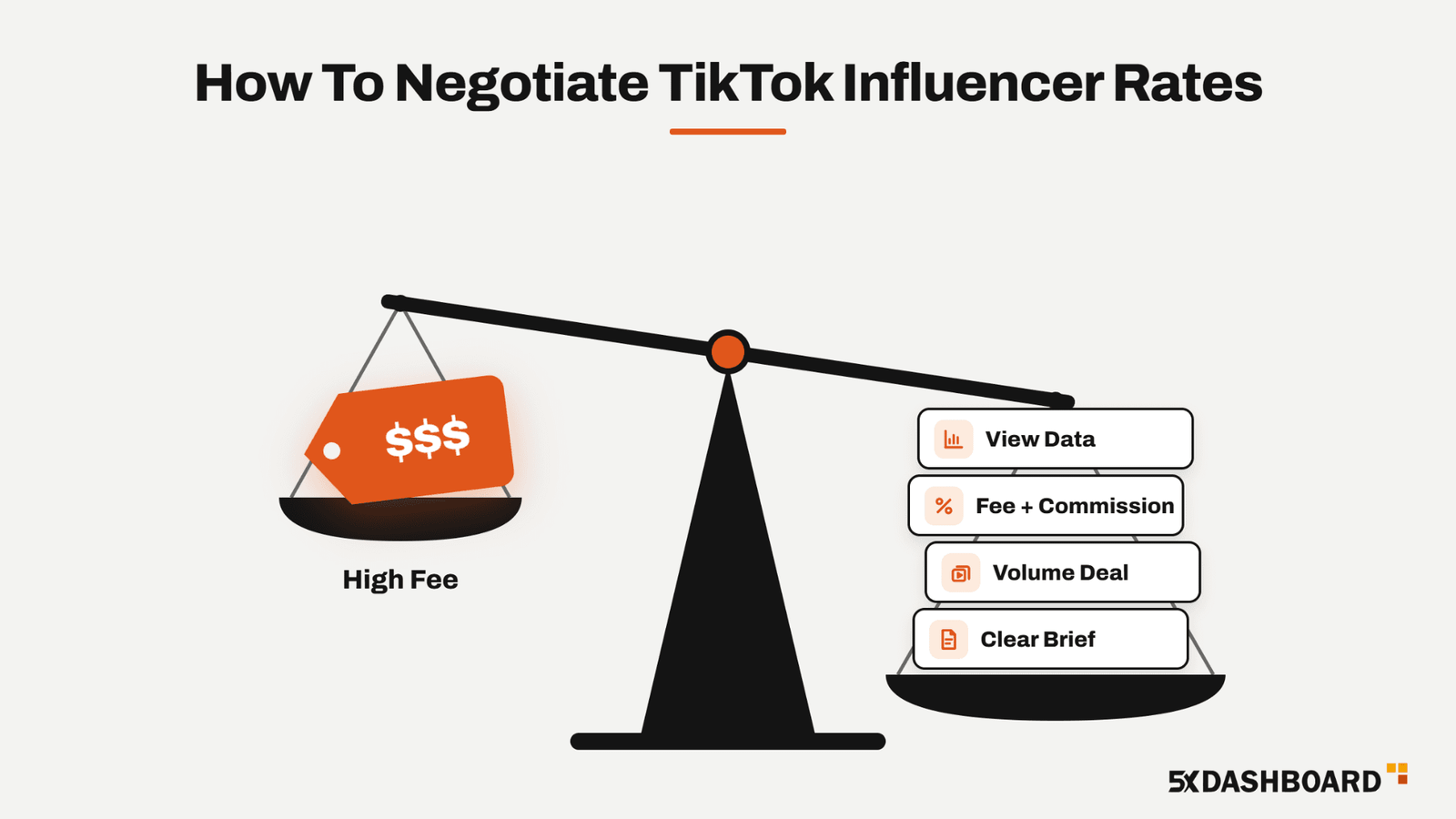
Before asking for a price, send the product, its price, number of videos, deadline, usage rights, and any exclusivity you need. A full brief lets the creator quote the whole job.
Trade Volume For A Lower Rate
Ask for a per-video price on a package of videos. Avenlur paid $20 to $30 per video for packages of 7 to 10 videos per creator. For L.O.C Astrology, we used our TikTok Shop affiliate community management tool to brief creators so each sample produced several posts. Shipping 5 to 7 samples a day produced 50 to 70 creator videos a day.
Offer Commission Upside
If a creator's fee is too high, offer a lower fee plus commission. The creator can earn more than the full fee if the video sells. You pay less if it doesn't. This works best with creators who have a strong sales history. Our TikTok Shop affiliate management team sets commission this way for each creator.
Back Your Offer With View Data
Show the creator your math. If their fee works out to a higher cost per view or a higher share of sales than similar creators, share the numbers and propose a price that matches their average results.
Common Mistakes When Paying TikTok Influencers
Approving Every Sample Request
Free samples are part of what you pay creators. Yappy Bracelets shipped samples to any creator with $500+ GMV, which cut into the margin on $14 items. We limited samples to proven high-volume creators and cut shipments to 49 a month, down from a backlog of 1,000+ requests.
For Avenlur, we held 1,600+ sample requests in review, including some from creators with $500K+ in GMV, and the shop still reached $156K in monthly GMV.
Booking New Creators Before Using Current Ones
You've already paid for samples from your current creators. Ask them for more videos before you pay new creators. The Yappy best seller had 27 creator videos in delivery. We asked creators who already had samples to film again, and the count reached 70.
Starting With A High Open Commission
A change to an open collaboration rate takes 30 days to take effect, while a target collaboration rate takes 5 days. If you launch an open collaboration at a high rate to attract creators, you keep paying that rate for a month after you lower it. Start the open rate low and offer higher rates to proven creators through target collaborations.
Running Creator Deals Without A Schedule
One-off creator deals make your sales jump up and down. Book creators to post every week instead. Selerb had about $230K in monthly GMV, with large swings between strong and weak weeks and no repeatable content system. We set up a creator pipeline that delivered videos every week, and monthly GMV reached $796K in 110 days.
Dropping Creators After Peak Season
Keep paying creators after your best month, because buyers don't stop all at once. TubShroom sells drain protectors, which peak in December for gifting and in January for post-holiday cleanup. We started seeding creators before the gifting window, and December 2025 hit $204,696 in GMV, up 69.34% over November. We kept the same creators posting through January, which closed at $195,057.
What To Include In The Creator Contract
- Number of videos, length, and posting dates
- Number of review rounds
- Usage rights: where you can use the video and for how long
- Spark Ads code and authorization period
- Exclusivity: named competitors and end date
- Payment: flat fee, commission rate, and when each is paid
- Samples: whether the creator keeps or returns the product
- Disclosure: how the creator will label the video as an ad
The FTC Disclosures 101 for Social Media Influencers says creators must disclose any financial relationship with a brand, including free products. In a video, the disclosure must appear in the video itself, not just the caption. Simple labels like “ad” or “sponsored” are enough.
Find Creators Who Fit Your Budget
If you're a seller looking for creators, we can help. Our TikTok creator management service matches you with creators from our 2,300+ community based on their sales history and niche, and we handle the deals for you.
If you'd rather pay creators only when they make a sale, start with our TikTok Shop affiliate management service. We recruit affiliate creators, set your commission rates, and keep creators posting. Book your free consultation or call us at +1-972-671-4522 to get started today.
TikTok Influencer Rates FAQs
Do TikTok influencers accept free products as payment?
Yes, some TikTok influencers accept free products as payment, especially nano creators. On TikTok Shop, creators request samples through your affiliate collaborations, and you approve or decline each one.
How do brands pay TikTok influencers?
Brands pay TikTok influencers a flat fee, a commission on sales, or both. On TikTok Shop, you pay flat fees upfront by card or from your Available balance, and commission is paid on each sale the creator makes.
How much does a TikTok influencer campaign cost in total?
A TikTok influencer campaign costs the total of your creator fees, commission on sales, product samples, usage rights or exclusivity fees, and ad spend if you run creator videos as ads.
Muhammad Ali co-founded 5x Dashboard, a certified TikTok Shop Partner (TSP) agency, and founded Kixmon, a profit and loss analytics tool for TikTok Shop sellers. He entered ecommerce in 2020 and co-founded the Amazon agency E-Commerce Villa, where he managed PPC and account growth for private-label brands and hosted a podcast featuring operators like Brian R. Johnson, who generated $2.2B in Amazon revenue. He moved fully into TikTok Shop in March 2024. Ali is a Helium 10 Certified Professional with a background in ACCA accounting that underpins his profit-first approach to ecommerce growth.